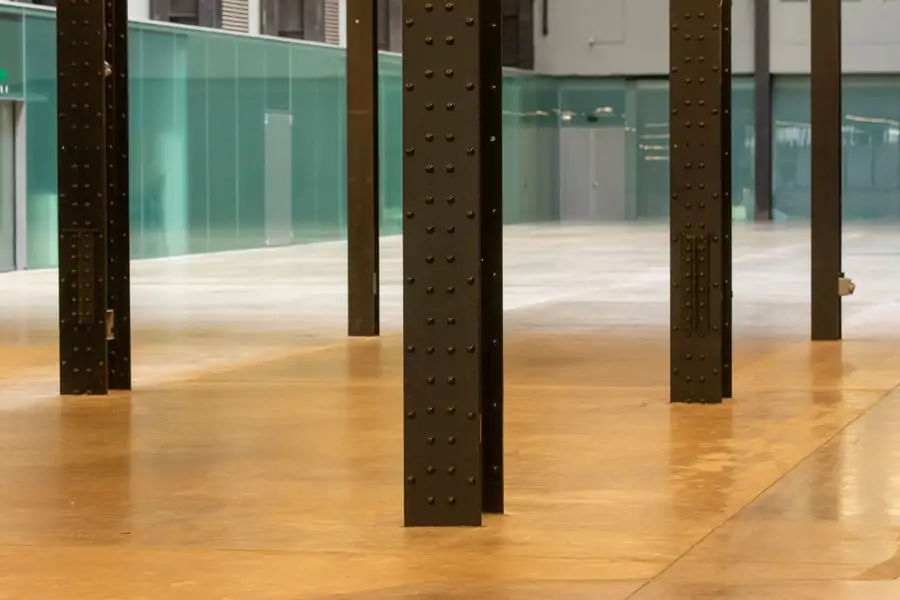
Pueblo has always been a working city. Evraz Rocky Mountain Steel is still one of the largest employers here alongside UCHealth Parkview Medical Center, the county, and CSU Pueblo, and the industrial footprint that grew up around the mill left behind a lot of concrete: warehouse bays, fabrication shops, distribution space along the I-25 and US-50 corridors, and the light industrial stock east toward Blende. Most of it has never had a proper floor system, just bare slab, dust and a failed gray paint job somewhere in its history.
A commercial floor coating is not a bigger version of a garage floor. The specification changes by zone, the removal survey drives the price more than the square footage does, and the schedule is usually the hardest constraint. This page covers how we approach all three.
Commercial Floor Types We Coat in Pueblo
High build epoxy with a polyaspartic wear coat, laid in phased bays so racking can be shuffled rather than emptied. Traffic lanes, hatched keep clear zones and dock door aprons specified separately from open storage areas.
Chemical resistance is the driver: brake fluid, gear oil, coolant, battery acid and hot tire contact on the same slab. A broadcast texture in the bay, a smooth finish in the parts area, and a coved edge where the floor meets the wall so wash down does not get underneath.
Coved integral base, a slip rated aggregate broadcast, and a system rated for thermal shock from hot water and steam cleaning. Almost always installed overnight or across a closure day, because a kitchen cannot lose a week.
Appearance carries more weight here. Metallic, polished concrete with a clear build, or a fine flake in a corporate color. Sound absorption and light reflectance both improve, which changes how a large retail space feels.
Impact and abrasion resistance first. Dropped stock, pallet jacks, welding spatter and forklift wheels. Higher build thickness and a system that can be spot repaired in place without shutting the shop.
Cleanability, seamlessness and infection control. Coved bases, no joints for anything to sit in, and finishes that survive daily disinfectant.
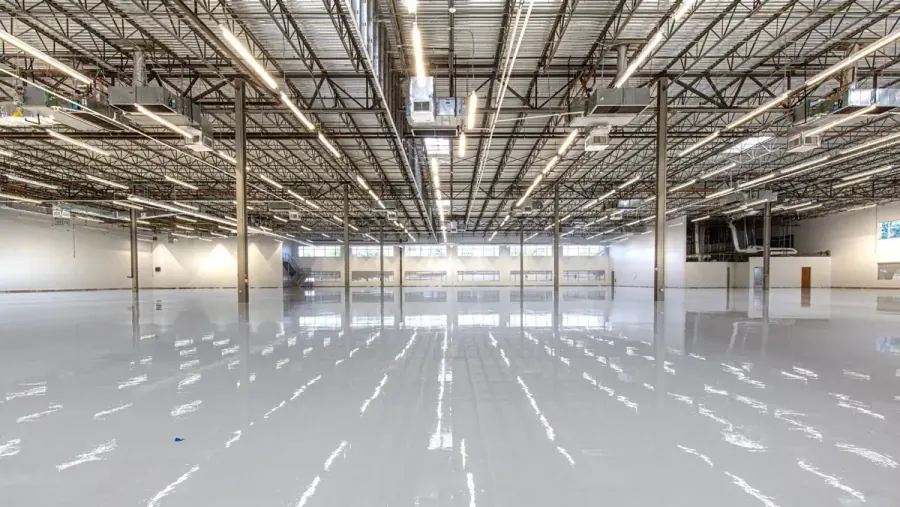
A high build coating across a large open commercial floor: seamless, light reflective and easy to keep clean.
Why the Removal Survey Sets the Price
On a residential garage, prep is a few hours of grinding and the outcome is predictable. On a 20,000 square foot commercial floor with four decades of history it is the entire risk of the project. We survey before quoting, and the survey answers four questions.
- 1What is on the slab now, and how thick?
Thin failing epoxy grinds off. Built up multi layer systems, urethane cement and heavy mastic often need shot blasting, which is a different machine, a different rate and a different dust plan.
- 2Is the concrete contaminated?
Oil and hydraulic fluid soak into an unsealed industrial slab and will keep bleeding back out after grinding. Contaminated zones need degreasing and sometimes a dedicated primer, and they need identifying before the quote, not on install day.
- 3What is the slab moisture reading?
Same calcium chloride and relative humidity testing as a residential basement, sampled across the footprint rather than in one place. Large slabs are rarely uniform.
- 4Where are the joints and cracks?
Control joints have to be honored, not coated over, or they will telegraph and split the film. Moving joints get a flexible joint filler; static cracks get chased and filled.
The full technical background is on the slab prep and moisture guide for Pueblo County.
Working Around Your Schedule
Downtime is usually the real cost of a commercial floor, not the coating. Three ways we keep it down:
- Polyaspartic chemistry for anything on a tight turnaround. Recoat windows in hours mean a Friday night grind and a Monday morning reopening is achievable. Details on the polyaspartic page.
- Phased bays on large floors, so a warehouse keeps operating on two thirds of its footprint while a third is being done.
- Out of hours and weekend crews, which is standard rather than a premium extra for kitchens, retail and medical space.
See the polyaspartic coating page for how the fast cure schedule actually works hour by hour.
Permits, Tenant Finish and Who to Call
Recoating an existing commercial floor is a finish and does not need a permit by itself. A tenant finish or a change of use does, and floor finishes form part of that submission along with the mechanical, electrical and life safety scope. Permits across the city and county run through the building department at 830 N Main St, Pueblo CO 81003 on 719-543-0002, open Monday to Friday 7:30am to 4:30pm. The City of Pueblo's Public Works handles separate concrete and excavation permits for anything in the public right of way, on 719-553-2295. Our Pueblo County permit guide sets out which case is which with links to the departments.
Where We Work Commercially
Across the City of Pueblo including the industrial corridor, the Union Avenue and Mesa Junction business districts, and the retail and light industrial stock along Highway 50 East and Northern Avenue. Out to the Pueblo West commercial strip along US-50, and south along I-25 toward Colorado City. Full coverage on the service area page. For residential work the same crew handles garage floor coating in Pueblo CO, basement floors and exterior patio and driveway coating. Send the building details through the contact page and we will book the survey.