A garage floor coating in Pueblo, CO costs roughly $5 to $8 a square foot installed, which puts a standard two car garage between $2,400 and $3,800. That is the number most people came here for, so it goes first. The more useful question is why two floors quoted at the same price per foot behave completely differently five years later, and the answer is almost always what happened in the eight hours before the first coat went down.
Pueblo is a genuinely hard market for concrete. The city sits at 4,692 feet where the Arkansas River meets Fountain Creek, in a cold semi arid climate that manages about 12 inches of precipitation and 28 inches of snow across roughly 3,470 hours of sunshine a year. A south facing garage with the door up bakes in July, and the same slab drops below freezing overnight on 14 or more days each winter. Under the slab, most of the county sits on the smectitic clay the USDA catalogued as the Denver series, established from the Pueblo Area soil survey in 1974 and carrying more than 35 percent clay to a depth of over 40 inches. That is a lot of movement and a lot of thermal cycling for a bonded film to survive.
Why Garage Floor Coatings Fail in Pueblo, and How We Stop It
Hot tire pickup
This is the failure people describe on the phone as "it peeled in the shape of my tires". Standard epoxy softens at sustained temperatures above roughly 140F. Your tires come off I-25 in August genuinely hot, the slab is already warm because the sun here is relentless, and the softened film bonds to the rubber and lifts a patch out when you reverse. Polyaspartic and polyurea remain slightly flexible after they cure and do not soften the same way, which is why every garage floor we build in Pueblo gets a polyaspartic top coat rather than being left as bare epoxy.
Magnesium chloride and the parking strip
Colorado runs magnesium chloride brine on the highways and it comes home on your car. Magnesium ions react with the calcium silicate hydrate that binds cement paste and convert it to a magnesium silicate hydrate that has no binding strength at all, and the brine simultaneously increases how much water gets pulled into the pore network so each freeze does more damage. That combination is why so many uncoated Pueblo garages have a crumbling, pitted strip exactly where the car parks while the rest of the slab looks fine. A properly bonded coating is a barrier: the brine never touches concrete.
Acid etch instead of a mechanical profile
The cheapest way to prepare a floor is to pour acid on it, rinse, and hope. It does not remove old sealer, it does not touch a previous coating, it leaves salts behind if the rinse is incomplete, and it produces an inconsistent profile. Every floor we do is opened mechanically with diamond grinders until the concrete has a uniform texture you can feel through a glove. That is the single largest reason a floor lasts 15 years instead of two, and it is also the reason a legitimate quote in this town is never the cheapest one you get.
Slab moisture nobody tested for
Pueblo is semi arid, which lulls people into skipping the moisture test. It should not. Snowmelt driven under a door, an old slab poured without a vapor retarder, irrigation against a garage wall in a Pueblo West yard, or simply a slab that has never been allowed to dry, all push vapor up through the concrete and lift a coating from underneath in blisters. We probe before we quote. Our slab prep and moisture guide for Pueblo County covers how the test is run and what the numbers mean.
Expansive clay that no coating can outvote
The Colorado Geological Survey puts the swelling pressure of the state's expansive clays at 20,000 to 30,000 pounds a square foot and names heaved, cracked garage and basement floor slabs as the most common visible symptom. A coating bridges shrinkage cracks. It does not restrain a slab that is being lifted by clay. If we look at your floor and the crack faces sit at different heights, we will tell you that first, because putting an expensive finish on a moving slab is how a homeowner ends up angry at a coating that was never the problem.
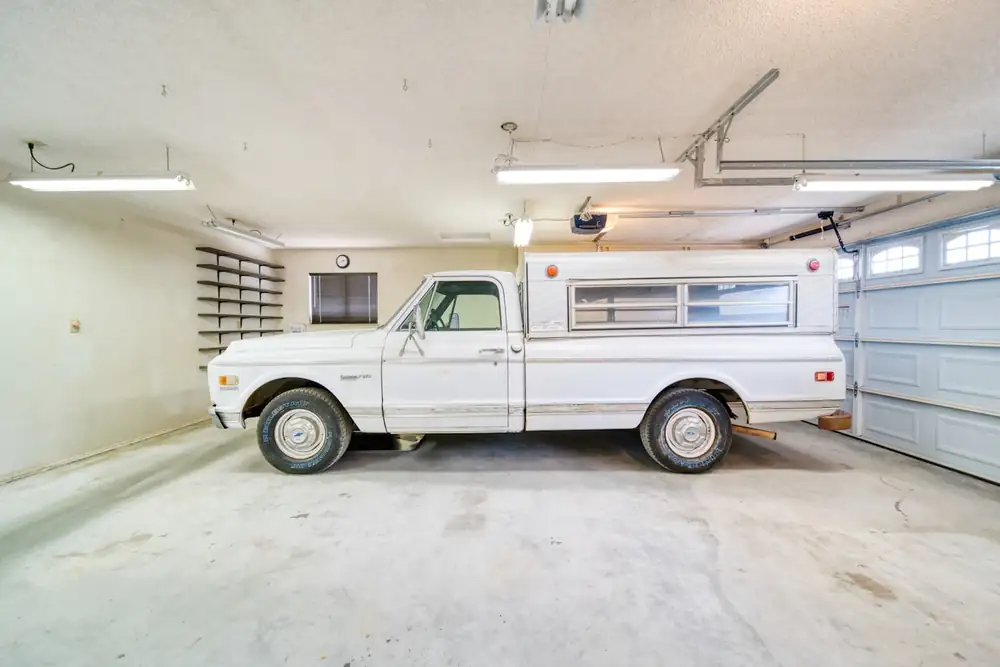
The typical starting point: an older Pueblo two car slab with surface wear, staining and open shrinkage cracks.
What We Actually Do to a Pueblo Garage Floor
One day on site for most residential garages, in this order. Nothing on this list is optional and nothing is padded.
- 1Clear and assess
You empty the garage the night before. We map cracks, check the door line, look for previous coatings, and run a moisture probe. Anything that changes the quote gets raised now, not halfway through.
- 2Diamond grind the slab
Walk behind grinders with dust extraction take the surface back to clean, open concrete. Old paint, sealer, glue and failed coatings come off here. Edges and corners get done with a hand grinder so there is no untreated perimeter band.
- 3Chase and fill cracks and spalls
Cracks get opened into a V, vacuumed, and filled with a flexible polyurea that moves with the slab. Spalled areas, especially the parking strip, get rebuilt with a patching mortar. Everything is ground flush once cured.
- 4Base coat
A pigmented epoxy or polyurea base is squeegeed and back rolled into the profile. This is the coat doing the bonding, so the grind quality from step two either pays off or does not.
- 5Broadcast flake to refusal
Vinyl flake goes into the wet base until the surface will not take any more. Broadcasting to refusal rather than scattering a light coverage is what gives an even color, a hidden repair line and real slip resistance.
- 6Scrape, vacuum, top coat
Once cured, the flake surface is scraped back flat and vacuumed. Two clear polyaspartic top coats follow, carrying the UV stability, chemical resistance and abrasion life.
- 7Cure and hand back
Foot traffic within hours. Vehicles at 24 to 72 hours depending on system and slab temperature. We tell you the actual number for your floor before we leave.
Choosing a System for Your Pueblo Garage
Three real choices, and the local conditions push fairly hard toward the middle one.
| System | Typical Pueblo cost | Life | Best for |
|---|---|---|---|
| Clear penetrating seal | $2 to $4 / sq ft | 3 to 5 years | A sound newer slab where you only want dust control and stain resistance |
| Epoxy base with polyaspartic top, flake | $5 to $8 / sq ft | 10 to 20 years | The default Pueblo garage. Hides repairs, grips wet, survives hot tires and brine |
| Full polyaspartic build | $6 to $9 / sq ft | 15 to 20 years | Winter installs, fastest return to service, maximum UV stability at the door line |
Ranges reflect installed pricing for the Pueblo market. Full breakdown on the Pueblo epoxy floor cost guide.
Why Pueblo Is a High Demand Market for Garage Coatings
Three things stack up here that do not stack up in most cities. First, the housing stock. Pueblo is Colorado's ninth largest city at 111,876 people, and a large share of that is mid century construction on the South Side, in Bessemer and around Eiler Heights where garage slabs are 50 to 70 years old and have never had anything done to them beyond a coat of porch paint. Those slabs are dusting and spalling and their owners are, quite reasonably, tired of it.
Second, the newer half of the market wants something different. Belmont, University Park, Regency Crest and the newer Pueblo West subdivisions have sound slabs on bigger footprints, and those owners are buying a finished room rather than a repair. Three and four bay garages, workshops and RV bays are common out on the Pueblo West acre lots, which is why our Pueblo West garage floor coating page deals with a different set of problems entirely.
Third, nobody local has been talking about the technical side. Every coatings company that shows up in a Pueblo search either drives down from Colorado Springs or across from Fremont County, and every one of them publishes the same generic copy about durability and easy cleaning with no pricing, no permit information and nothing about the clay, the brine or the altitude. That is the gap this site exists to close.
Looking After a Coated Floor in This Climate
- Rinse the parking strip a few times over winter. The coating is not at risk from mag chloride, but rinsing keeps the brine off the door line joint and out of any expansion cut.
- Use a soft broom or a dust mop for daily grit. Southern Colorado grit is sharp and abrasive, and it is the only thing that will genuinely dull a polyaspartic top coat over time.
- Put a mat under a jack stand or an engine hoist. The coating resists impact well and point loads badly.
- Skip the muriatic acid, the wire brush and anything solvent based. Warm water and a neutral cleaner is all it needs.
- Expect to want a refresh top coat at around year 10 to 12 in a busy garage. That is a one day job with no grinding, and it resets the wear life.
Where We Coat Garage Floors
Across the City of Pueblo, including Belmont, University Park, Regency Crest, Sunset Park, Highland Park, Eiler Heights, Bessemer, the Mesa Junction area, the South Side and Blende. Out west along US-50 through Pueblo West. South down I-25 and CO-165 to Colorado City, Rye and Beulah. East along US-50 to Blende, Avondale and Vineland. Full list on the service area page, and if you are unsure whether you are inside it, ask on the contact page and we will tell you straight.
If your project is not a garage, the same crew and the same prep standard covers basement floor coating in Pueblo CO, commercial epoxy flooring in Pueblo CO and patio and driveway coating in Pueblo CO.