Concrete Slab Prep and Moisture in Pueblo County, CO
Every failed floor coating in this county failed for one of four reasons, and three of them were decided before the first coat went down. Here is what the ground, the climate and the road salt are doing to your slab, and how to find out where yours stands.
A resin coating is only ever as good as its bond to the concrete underneath it. That bond is decided by four things in Pueblo County: how the surface was profiled, how much moisture the slab is passing, whether the slab is structurally stable, and what chemistry has already been driven into the concrete. Get those right and a coating outlives the vehicle parked on it. Get any one of them wrong and no product on the market saves the job.
1. Surface Profile: Grind, Do Not Etch
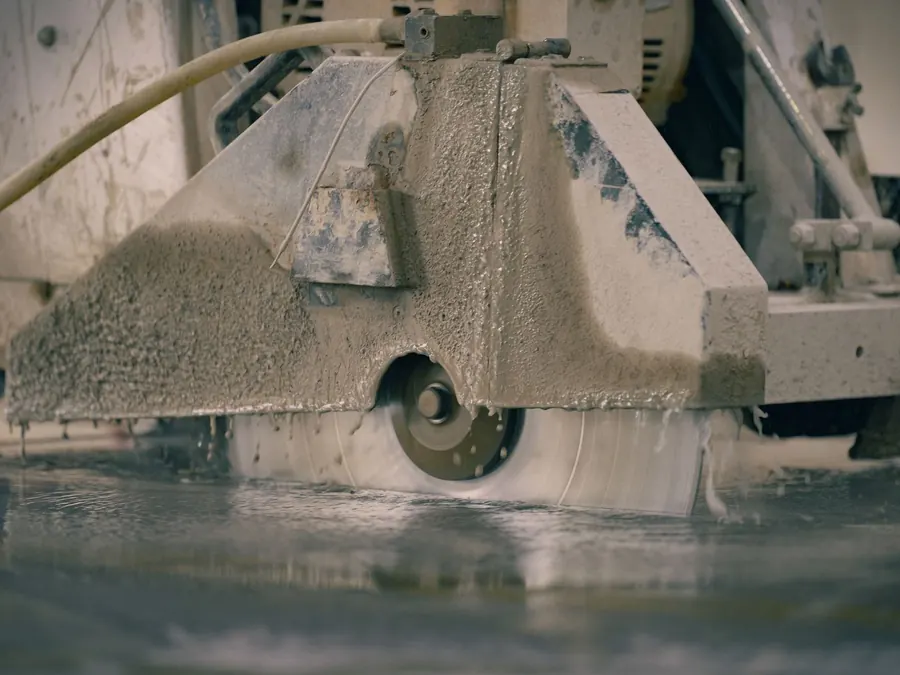
Concrete Surface Profile is a standard scale from CSP 1, roughly what acid etching produces, up to CSP 9 for heavy scarification. A typical garage or basement coating system wants CSP 2 to 3, which is what diamond grinding delivers. High build and self levelling systems want a coarser profile and are usually shot blasted.
Acid etching is popular because it is cheap and requires no machinery, which is why every DIY kit recommends it. It has four problems, and in this county all four bite. It does not remove existing sealers, paints or coatings. It does not touch oil contamination. It leaves an inconsistent profile that is aggressive where the acid pooled and barely touched where it ran off. And if the rinse is not thorough it leaves salt residue on the surface, which is a bond breaker in its own right. On top of that, in Pueblo West and the rural parts of the county where properties are on wells and septic systems, disposing of the acid rinse is its own problem.
The check you can run yourself on a ground floor: put a glove on and run your palm across it. It should feel uniformly gritty, like fine sandpaper, everywhere. Smooth patches mean the grinder skipped them. Glossy patches mean old sealer survived. Both will show up later as the first places the coating lets go.
2. Slab Moisture: Test It, Do Not Assume Semi Arid Means Dry
Pueblo receives about 12 inches of precipitation a year in a cold semi arid climate, which makes it very tempting to skip moisture testing. That instinct is wrong, and it is wrong for reasons specific to this area. Older slabs across the South Side, Bessemer and Eiler Heights were poured before vapor retarders were standard. The dominant soils under the county have slow to very slow permeability, so when spring melt or a monsoon burst saturates the ground, the water sits against the concrete rather than draining away. Landscape irrigation on a Pueblo West acre lot puts water against a foundation every week through summer. And a swamp cooler, common here, adds a lot of humidity to an enclosed space in July.
Two standard tests, and a rough screening check anyone can do.
A dish of anhydrous calcium chloride sits sealed to the slab for 60 to 72 hours and is weighed before and after. The result is pounds of moisture vapor emitted per 1,000 square feet per 24 hours. Standard systems want a low single digit figure.
A probe sits in a drilled hole in the slab and reads internal RH once equilibrated. More reliable than the calcium chloride test because it measures the slab at depth rather than what happens to be evaporating off the surface that day. Most systems want under about 80 percent.
Tape a two foot square of clear plastic to the slab, sealed on all four edges, for 24 to 48 hours. Condensation underneath or a darkened patch of concrete means the slab is passing vapor. It proves the problem, it cannot size it.
A high reading is not a refusal. It means the system changes: a moisture tolerant epoxy primer formulated to bond and hold under vapor pressure goes down first, and the build sits on top of that. Skipping the test is what produces the blistered, bubbled floors that look like the coating was applied over water, because functionally it was. This matters most on the basement floors we quote.
3. Expansive Clay: What a Coating Can and Cannot Do
The USDA established the Denver soil series from the Pueblo Area, Colorado survey in 1974. It is classified as fine, smectitic, mesic Torrertic Argiustolls, which in plain terms is a clay loam to clay carrying more than 35 percent clay to a depth of over 40 inches, with slow to very slow permeability and vertic shrink swell behavior. Smectite is the clay family that includes montmorillonite and bentonite, and it is the reason concrete moves here.
The Colorado Geological Survey puts numbers on it: these clays can expand up to 20 percent by volume when they take on water, and exert pressures of 20,000 to 30,000 pounds a square foot against anything confining them. The survey names cracked and heaved sidewalks, patios, driveways, and garage and basement floor slabs as the most common visible indicator of expansive clay across the state, and notes that annual losses from expansive soils exceed those from tornadoes, floods, earthquakes and hurricanes combined.
Practically, that gives a clear dividing line. A coating with a flexible polyurea crack fill handles ordinary shrinkage cracking permanently: the crack is chased into a V, vacuumed, filled and ground flush, and under a flake broadcast it disappears. A coating does nothing about a slab being lifted by clay. If the two faces of a crack sit at different heights, if the crack has widened noticeably in recent years, or if a door that used to close no longer does, that is movement, and it is a structural conversation rather than a coatings one. We would rather have it at the estimate.
You can look up what is under your own address in a couple of minutes on the USDA Web Soil Survey, linked below.
4. Chloride Contamination: What Winter Leaves Behind
Colorado runs magnesium chloride brine on the highways, and it behaves differently from ordinary rock salt. Sodium, potassium and calcium chlorides are chemically fairly innocuous to concrete. Magnesium is not: magnesium ions accumulate and react with the calcium silicate hydrate that gives cement paste its strength, converting it into a magnesium silicate hydrate which is non cementitious, meaning it holds nothing together. The brine also increases how much water is drawn into the pore network, so every subsequent freeze does more damage than it otherwise would. Concrete less than a year old is at greatest risk.
In a Pueblo garage this shows up as a distinct band of pitting and spalling exactly where the car parks, with the rest of the slab looking comparatively fine. Two consequences for prep. First, that band is often too soft to coat directly and has to be ground back to sound concrete and rebuilt with a patching mortar. Second, chloride contamination has to be washed out before coating rather than sealed in, because trapping it under a film is how you get blistering from underneath a year later.
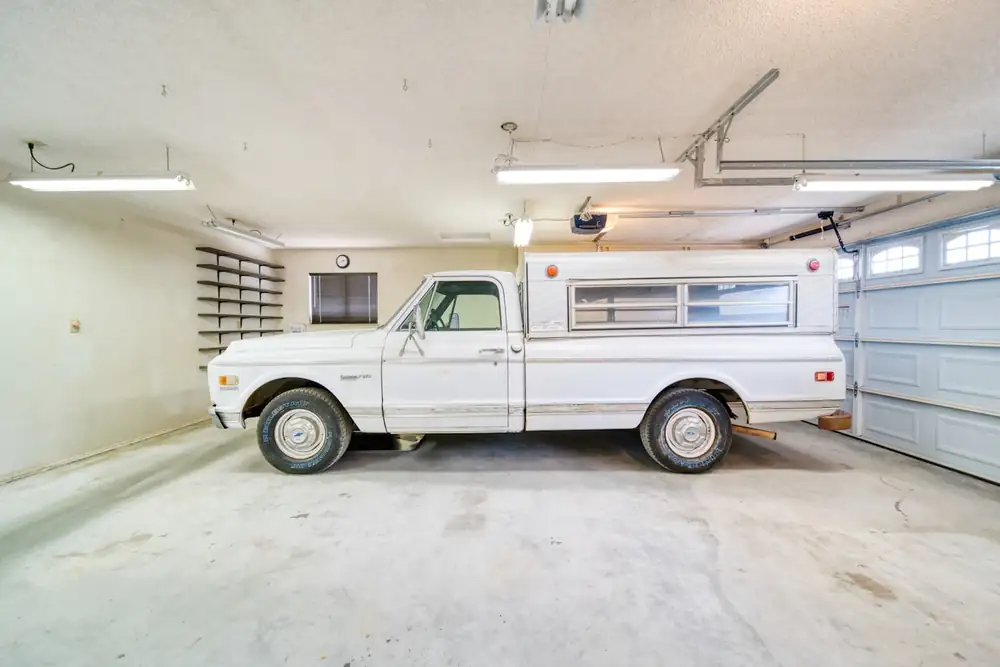
Surface wear and staining across an older Pueblo County slab, the usual condition before grinding.
A Prep Checklist You Can Hold a Contractor To
- Mechanical profiling stated in the quote: diamond grinding or shot blasting, never acid etching.
- Edges and corners ground by hand, so there is no untreated perimeter band under the coating.
- Moisture test carried out and the actual reading shared with you, especially on any basement.
- Crack scope written out: chase, vacuum, flexible polyurea fill, grind flush.
- Spalled or chloride damaged areas ground back to sound concrete and rebuilt, not skimmed over.
- Contamination check for oil, and a plan for it if found, rather than a discovery on install day.
- Slab temperature and dew point checked on the day before any material is mixed.
- Control joints honored with a flexible filler rather than coated over rigidly.
Sources
Every technical claim above comes from one of these. They are worth ten minutes if you are about to spend several thousand dollars on a floor.
The state survey on montmorillonite and bentonite clays underlying populated Colorado. Swelling up to 20 percent by volume, pressures of 20,000 to 30,000 pounds a square foot, and cracked and heaved garage and basement floor slabs named as the most common visible indicator.
The formal description of the soil series established from the Pueblo Area, Colorado survey in 1974. Fine, smectitic, mesic Torrertic Argiustolls, clay loam to clay, more than 35 percent clay to a depth of more than 40 inches, slow to very slow permeability.
Look up the soil series under your own parcel. Free, and it takes about two minutes once you find your address on the map.
Research on why magnesium chloride behaves differently from other road salts: magnesium ions convert calcium silicate hydrate into a non cementitious magnesium silicate hydrate, and the brine increases water uptake into concrete pores. Concrete under one year old is most at risk.
Once you know what the slab is doing, the practical pages are garage floor coating in Pueblo CO, polyaspartic systems and the cost guide. Coverage is on the service area page, and we will run the moisture and crack assessment as part of a free estimate booked through the contact page.
Slab Prep and Moisture in Pueblo County: Frequently Asked Questions
What is the single most common reason a floor coating fails in Pueblo?
Preparation, and specifically acid etching instead of mechanical grinding. Etching does not remove an old sealer or coating, it does not open a consistent profile, and if the rinse is imperfect it leaves salts on the surface that stop the new coating bonding. Almost every peeling garage floor we are called out to look at in Pueblo was etched rather than ground. Grinding costs more and takes longer, which is exactly why the cheapest quote is so often the one that fails.
How do I test my own slab for moisture before calling anyone?
Tape a two foot square of clear plastic sheet flat to the concrete, sealed on all four edges, and leave it 24 to 48 hours. If there is condensation on the underside afterwards, or the concrete beneath it has visibly darkened, the slab is passing moisture vapor. That tells you a problem exists but not how large it is. Quantifying it takes a calcium chloride test or an in situ relative humidity probe, which any competent contractor should be doing before quoting a basement.
What moisture readings are acceptable?
Most standard coating systems want in situ relative humidity below about 80 percent, and a calcium chloride result in the low single digits of pounds per 1,000 square feet per 24 hours. Above that you are not stuck, you just need a moisture tolerant epoxy primer designed to bond under vapor pressure rather than a thicker top coat. The mistake is proceeding without knowing the number at all.
Is my slab moving, or just cracked?
Run a fingertip across the crack. If the two sides sit at the same height and the crack is a consistent hairline, that is ordinary shrinkage and it fills and coats fine. If one side is proud of the other, the crack widens noticeably along its length, or it has visibly opened over the last year or two, the slab is moving. A coating bridges the first and cannot restrain the second. In Pueblo County, with the Denver series clay under most properties, the second case is not rare.
What is CSP and what number should my floor be ground to?
Concrete Surface Profile, a scale from CSP 1 for an acid etched surface up to CSP 9 for heavy scarification. Thin film coatings such as a typical garage system want roughly CSP 2 to 3, achieved with diamond grinding. High build and self levelling systems want a coarser profile from shot blasting. The practical check is that a properly ground floor feels uniformly gritty through a glove with no smooth patches and no glossy areas where old sealer survived.
Does the altitude in Pueblo affect how coatings cure?
Not the altitude directly, but the conditions that come with it do. At 4,692 feet with very low humidity and around 3,470 hours of sunshine a year, solvent flash off and surface skinning happen faster than on the product data sheet, which was written for average conditions. That shortens the working window and makes lap marks easier to leave behind. It is a crew skill issue rather than a product problem, and it is one more reason a fast setting polyaspartic is a poor DIY choice here.
Have the slab assessed before you spend anything
Moisture check, crack mapping and an honest verdict on whether your floor is a candidate. Free, across Pueblo County.